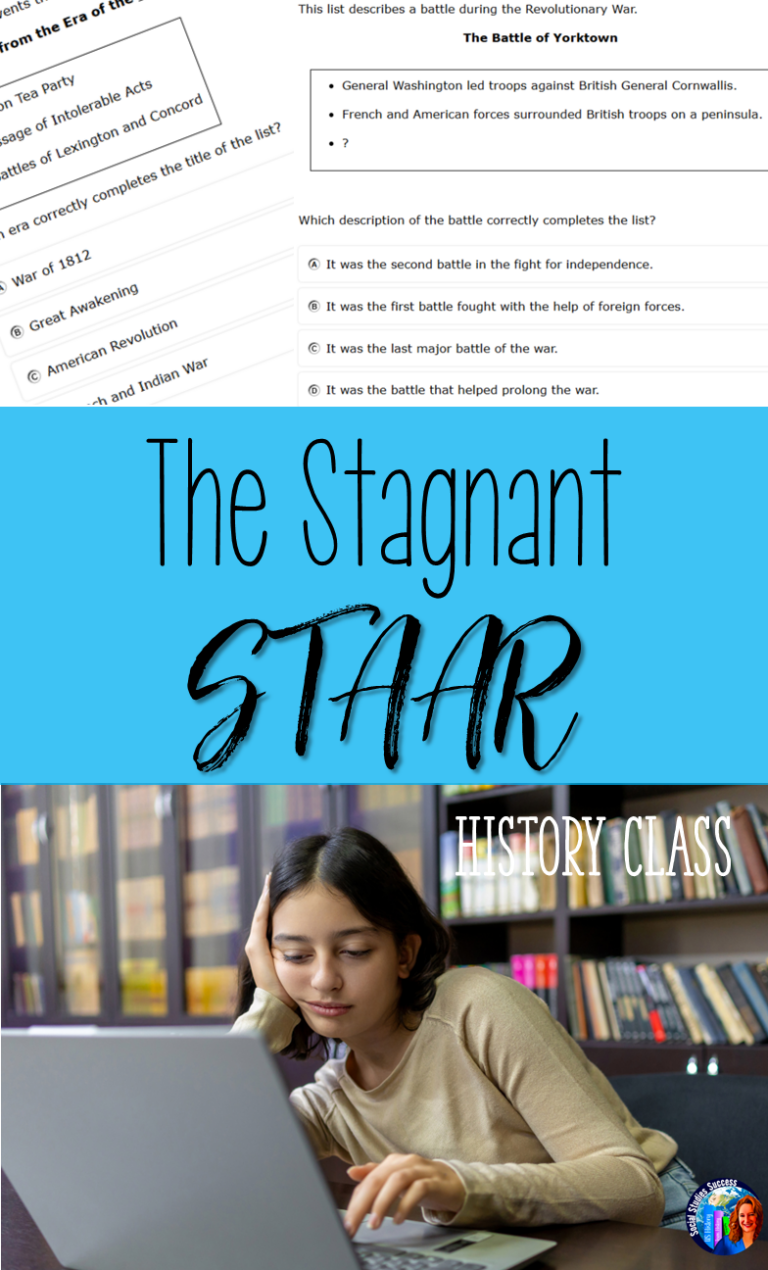
Why Our 8th-Grade Social Studies Scores Won’t Budge — and Two Things That Would Actually Move Them
If you’ve been watching the 8th-grade Social Studies STAAR results for the last few years, you already know the story: the line is flat. Not collapsing, not climbing — flat. And flat is its own kind of frustrating, because it’s the result you get when a lot of real effort goes in and nothing comes out the other side.
I dug into three years of statewide results alongside the redesigned test itself to figure out why. The short version: the scores aren’t stuck because kids don’t know enough history. They’re stuck because the test stopped rewarding knowing history and started rewarding reasoning over sources — and most instruction hasn’t made the same shift. I’ve spent years training Social Studies teachers and consulting in classrooms, and this is the gap I keep seeing.
The problem in one picture
Across the state, the average scale score moved about nine points over three years. On a scale where district scores spread out by more than 200 points, that’s noise, not progress. Underneath the flat average, districts rose and fell in almost equal numbers — a coin flip that cancels itself out. There’s plenty of motion; there’s just no shared direction. High performing districts dropped and lower performing districts grew… leaving flat results statewide.
Meanwhile, the redesigned test tells you exactly where students are losing ground. On the foundational, most heavily weighted standards — the causes of the American Revolution, unalienable rights, the Bill of Rights, core constitutional principles — students are answering correctly only 15 to 30 percent of the time. Those aren’t trivia items. They’re the load-bearing walls of the entire course. When the foundation sits at one-in-five, there’s a ceiling on everything built above it.
So why isn’t more teaching fixing it? Because of what the test now asks students to do. Here are the two conclusions I keep coming back to — the ones that follow most directly from the data, and that shape how I think every 8th-grade course should be built.
Conclusion 1: Build the course around source analysis, not content delivery
The items on this test are not recall questions. They live at Depth of Knowledge levels 2 and 3: students have to interpret primary documents, figure out where a principle actually comes from (is this Marbury v. Madison or the Bill of Rights?), and reason through cause and effect. A student who memorized that the cotton gin existed still can’t answer an item asking them to analyze its effects.
That gap is the whole problem in miniature. “Knowing the content” and “passing the item” have become two different targets. Class time spent on recall — timelines, vocabulary lists, lectures students copy down — builds the first target and barely touches the second. The knowledge doesn’t transfer to a test built on reasoning, so the effort is real but the score stays flat.
What transfers is practice that looks like the test. That means daily work with primary sources and two relentless questions: What does this show? Why does it matter? Put a primary source in front of students, ask them to say what it tells us and why it’s significant, and do it often enough that analysis becomes a habit rather than an event. The content still matters — but it should arrive through sources students reason about, not in lectures they memorize and a test they then reason on cold.
Conclusion 2: Treat reading proficiency as part of the Social Studies plan
There’s a second bottleneck hiding underneath the first, and it’s easy to misread as a history problem when it isn’t one.
These items are reading-heavy and source-heavy. To answer them, a student first has to decode dense stimulus text and unpack academic vocabulary — before any historical thinking even begins. That means a meaningful chunk of the social studies score is gated by reading ability. For your lower-performing students especially, the thing standing between them and a correct answer may not be that they don’t know the history. It may be that they can’t get through the passage.
If that’s true, then treating a flat Social Studies score as purely a content problem will keep producing flat results, because you’re solving the wrong problem. The more productive move is focus on content reading instruction in your own classroom. Students need explicit work on academic vocabulary, the specific language of sourcing and documents, and the plain reading stamina it takes to work through a dense primary or secondary source without giving up. Social Studies and reading aren’t separate projects on this test. The score lives at their intersection.
How we built socialstudies+ around this
Everything above is the reason Social Studies+ exists. When Jodi and I built the program — a partnership between Social Studies Success® and lead4ward, designed for the redesigned 8th-grade course — we didn’t organize it around covering content faster. We organized it around the two things the test actually rewards.
Take one of our lessons on the Declaration of Independence. It doesn’t ask students to memorize a date and move on. It opens by having them analyze two period paintings, then walks them through the document itself in six primary-source excerpts they have to read and reason about, returning again and again to what does this show, and why does it matter? It closes with a short constructed-response task scored on a two-part rubric — one point for explaining the idea, one point for explaining why it mattered. That’s the exact move students lose points on when they answer only half of a two-part STAAR item. We make them rehearse it.
The same lesson treats reading as part of Social Studies rather than someone else’s job. It front-loads the academic vocabulary the document depends on — grievance, consent, tyranny, unalienable rights — builds in guided reading and structured partner talk, and provides read-aloud supports for students who can’t yet decode dense founding-era language on their own. That’s the bottleneck we keep coming back to: a student who understands the history but can’t get through the passage looks, on a test score, exactly like a student who doesn’t know the content. We design so that reading is scaffolded, not assumed.
I want to be straight about evidence, because this whole post is built on reading data honestly. Across campuses that used the program over multiple years, the most encouraging signal is at the Meets level — the deeper-learning indicator — where the cohort moved up over two years, with a number of campuses posting sizable gains. What I’ll say is narrower and, I think, more useful: the test changed, and these materials are built for the test it became.
The bottom line
The flat line isn’t a mystery and it isn’t a verdict on anyone’s effort. It’s what you’d predict from a redesigned test that rewards reasoning over sources, layered on instruction still organized around delivering and recalling content, layered on reading demands we haven’t fully accounted for.
The encouraging part: both fixes are within reach and neither requires new content. Teach students to reason over documents the way the test asks them to, and make sure they can actually read the documents in the first place. Move those two things, and the line that’s been flat for years finally has somewhere to go.
Check out socialstudies+ here, and if you are interested in short online PD sessions, you can find them here.