The Philosophy Behind Every Lesson I Create
If you’ve ever downloaded one of my lessons, sat through one of my workshops, or read a post here, you may have noticed something. Whether the topic is the Constitution, the Civil War, World Cultures, or Economics, my lessons all have a similar feel to them. They aren’t collections of activities I liked the look of. They follow a consistent philosophy about how middle school students actually learn.
Teachers ask me about it all the time. How do you decide which activities to include? Why do your lessons flow the way they do? How do you balance engagement with rigor?
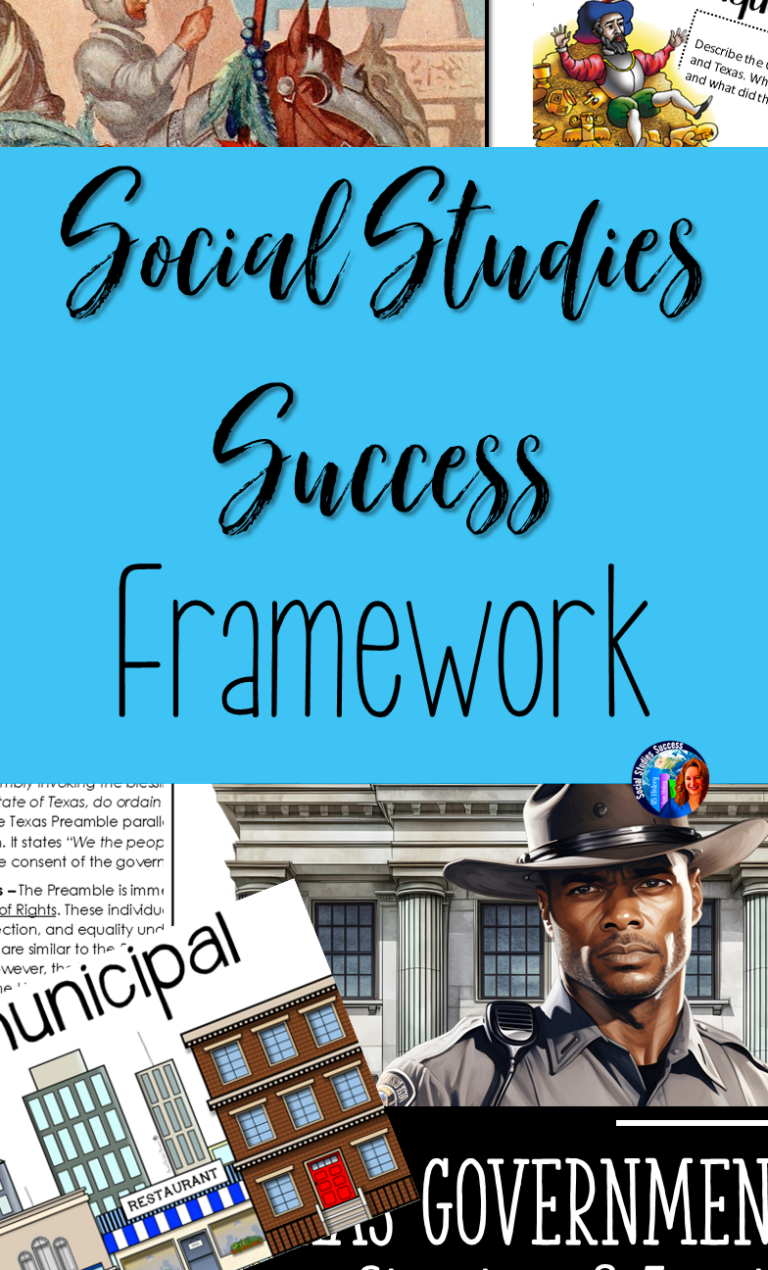
The answer is that every resource I create is built on what I call the Social Studies Success® Framework.
This framework didn’t appear overnight. I remember my first year teaching, when my principal told me to use stations… and that was the entire instruction I was given. Use stations. Not very helpful. And when I look back at the tests I wrote in those early years, I cringe — thirty low-level “do you know these random facts” questions, trivial pursuit dressed up as assessment. It took years of trial and error, curriculum work, and a lot of conversations with teachers across the country before the pattern underneath my best lessons became clear enough to name.
It Always Begins with Two Questions
Before I create a single activity, worksheet, or slide, I ask myself two questions:
What content is required?
How can I make that content engaging and meaningful for a middle school student?
Notice what I don’t ask. I don’t start by looking for a game. I don’t scroll Pinterest for a cute activity. I don’t ask ChatGPT to generate a worksheet.
I begin with the standards and the essential learning students need, and then I design experiences that help students connect with that content in a meaningful way. The order matters more than anything else in this post.
For me, engagement is never the goal. Meaningful learning is the goal. Engagement is how we get there.
Five Principles Guide Every Lesson
1. Purpose Before Activity
Activities should never drive instruction. Every strategy, discussion, graphic organizer, or game exists because it helps students better understand important content. If an activity doesn’t deepen learning, it doesn’t belong in the lesson — no matter how much fun it looks like on a Friday afternoon.
This is the hardest principle to hold onto, because activities are the fun part of planning. But an artifact box works for introducing an era or a region precisely because the spiral questions behind it move students from observation to analysis: What do you see? What do you think each artifact represents? Can you categorize them? Is there a cause and effect relationship between any of them? Take those questions away and you’ve got a box of stuff from Goodwill.
2. Students Learn by Thinking Like Historians
Social Studies is so much more than memorizing names and dates. Students should question evidence, analyze primary sources, compare perspectives, identify cause and effect, evaluate historical decisions, and support claims with evidence.
History is not trivia. History is thinking.
This is also why I keep coming back to the same two questions with every source I put in front of students: What does this show? Why does it matter? Students who practice that move all year long are not thrown by an unfamiliar excerpt in April, because analysis has become a habit rather than an event.
3. Literacy Lives Inside Social Studies
Reading, writing, vocabulary, speaking, and listening are not separate initiatives competing with us for instructional time. They are how students learn Social Studies.
Students become stronger readers by reading rich informational text. They become stronger writers by writing about history. They become stronger thinkers by discussing complex ideas.
But we can’t just assign “Chapter 5, Section 1” and expect comprehension to happen. Structures have to be in place before, during, and after reading — an anticipation guide to surface what students already believe, annolighting or a visual summary while they’re in the text, a dialogue or a mosaic afterward so the content doesn’t slip away. Literacy isn’t something we add to Social Studies. It’s woven into every lesson.
4. Learning Requires Processing
One of the biggest mistakes we make as teachers is assuming that because we taught something, students learned it.
Learning happens when students process information — when they discuss it, write about it, debate it, sort it, sequence it, argue about which event mattered most. Every lesson should end with students doing something meaningful with what they’ve learned, and that something should require more of them than recall. Hexagonal thinking is my favorite example. Students have to explain why two concepts connect, and the conversations you overhear while they arrange the tiles tell you more than any exit ticket will.
5. Engagement Must Have Purpose
Middle school students deserve lessons that capture their curiosity. But engagement doesn’t mean entertainment.
Students are engaged when they solve problems, debate ideas, investigate mysteries, analyze historical images, and wrestle with essential questions. A reading challenge works not because there’s a puzzle in it, but because the puzzle can only be solved by understanding the reading. Purposeful engagement creates meaningful learning. Engagement for its own sake creates a fun Tuesday and nothing on Thursday.
What This Looks Like in Every Lesson
Although my lessons cover many different topics, they follow the same instructional architecture:
- Essential Question – a compelling question that drives inquiry
- Objectives – clear learning targets aligned to standards
- Vocabulary – intentional instruction that prepares students for reading and discussion
- Engage – activities that activate curiosity and build background knowledge
- Learn – reading, note-taking, visual analysis, and explicit instruction
- Practice – opportunities to apply historical thinking through meaningful activities
- Process – authentic application where students revisit the Essential Question and demonstrate understanding
This sequence isn’t accidental. Each phase prepares students for the next, moving them from curiosity to understanding to application. Skip the vocabulary and the reading falls apart. Skip the processing and the content evaporates by the unit test.
Why This Matters
Our students face increasingly complex texts, complicated historical issues, and real civic responsibilities. Our job isn’t simply to help them remember information for a test. Our job is to help them think critically, communicate clearly, analyze evidence, work with other people, and make sense of the world around them.
That’s why every Social Studies Success® resource is built around purposeful engagement, disciplinary literacy, historical thinking, and meaningful learning.
My hope is that this framework doesn’t just improve one lesson. I hope it changes how you think about planning all of them. Because when students are genuinely engaged, supported through literacy, challenged to think deeply, and given real opportunities to apply what they’ve learned, Social Studies stops being another subject on the schedule.
It becomes the place where students learn to understand the past, make sense of the present, and prepare for the future.
That’s what Social Studies Success® is all about.
You can explore resources built on this framework in my shop, and find yearlong support through my membership program and socialstudies+