They Read It. They Still Can’t Tell You What It Said.
You assigned the reading. You gave them highlighters. You walked the room and saw yellow on every line of the page — which is the same thing as yellow on none of it.
Then you asked what the section was about, and the room went quiet.
If that scene feels familiar, I want to say something first: this is not a discipline problem, and it is not a “these kids just won’t read” problem. It’s a text problem, and it belongs to us. Our students are struggling with reading – literacy rates across the country have dropped. Do you have the strategies you need to help students be successful reading Social Studies content?
Social Studies text is genuinely hard
Our textbooks are written in a register almost no middle schooler uses. A single paragraph can carry three unfamiliar proper nouns, a cause-and-effect chain, an assumed piece of background knowledge, and a term that means something different in history than it does anywhere else. Kate Kinsella calls text like this “inconsiderate” — it’s not written to be helpful to the reader. Our students aren’t failing to read. They’re being handed something nobody taught them to read.
That’s why sending them off to conquer the chapter alone doesn’t work. It also can’t be outsourced. The ELA teacher down the hall is doing important work, but she isn’t teaching your students to read about the annexation of Texas. Nobody can do that but you.
Here’s the good news: this doesn’t require a new curriculum. It requires a small number of routines, used often enough that students stop treating them as activities and start treating them as how we read in here.
Reading happens in three stages
Every strategy I use fits into one of three places: before students read, while they read, or after they read. The stage is what matters, because each one solves a different problem.
Before Reading is where you buy yourself everything else. Students who arrive at a passage with no background knowledge and no purpose are just decoding. Twenty minutes of struggle gets you nothing.
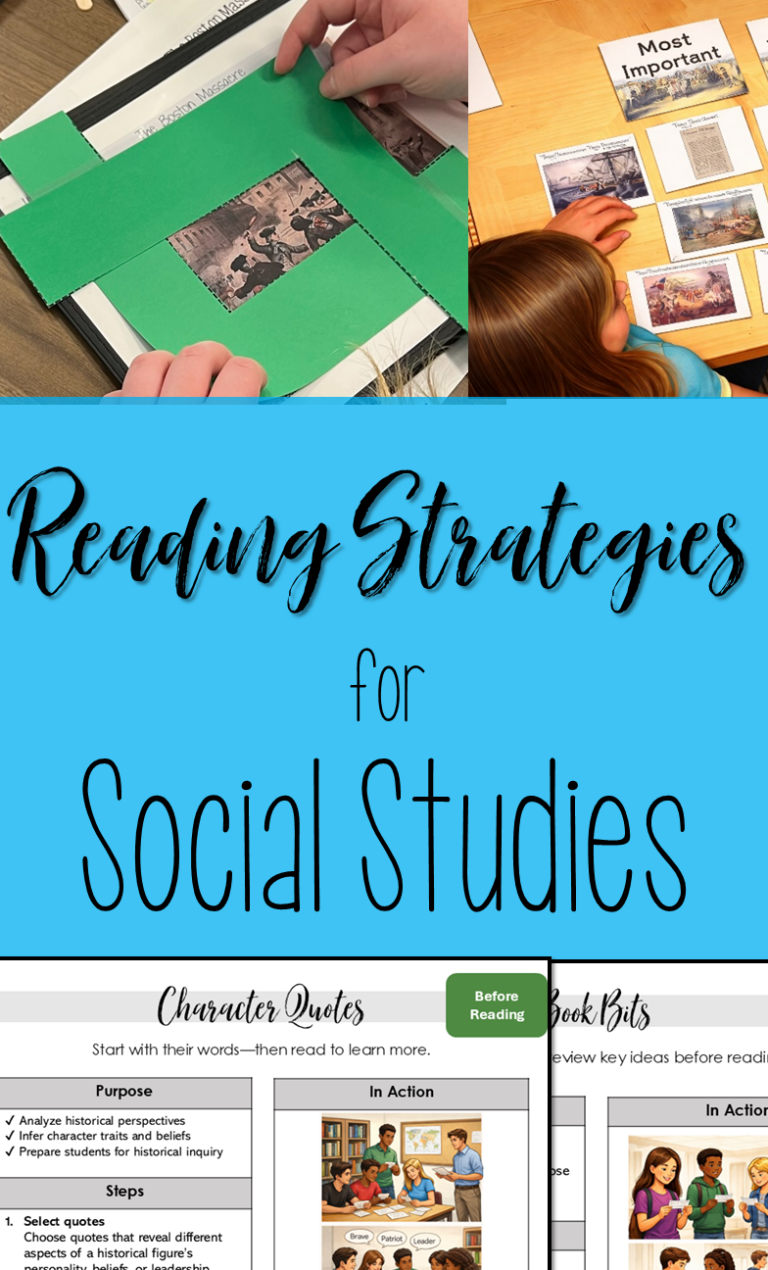
So build the knowledge first. Use an Anticipation Guide to surface what they already believe — including the wrong things, which are far more useful to you visible than hidden. Use Book Bits, where students get single sentences pulled from the text and predict what the reading is about. Use Card Sort to let them find patterns before you name them. Use Crop-It with a photograph, revealing one detail at a time, so a primary source becomes something they investigate instead of something they scroll past.
None of these take long. All of them mean students open the text already holding something.
During Reading is where you keep them working. This is the stage most of us skip, and it’s the one that decides whether the reading actually happens.
Start with a Think Aloud — narrate your own confusion out loud as you read a hard paragraph. Students have never seen a competent reader struggle. It’s a revelation to them that you go back and reread too.
Then give them a job. Text Coding turns marking up a page into thinking, because a symbol requires a decision. Annolighting fixes the yellow-everything problem directly: highlight the phrase, then write in the margin why it matters. If you can’t say why, you don’t highlight it. Beat the Teacher asks students to write questions hard enough to stump you, which sends them back through the passage with more attention than any comprehension worksheet ever earned.
After Reading is where learning gets processed and stored. Reading without processing is reading that evaporates by Friday.
Gist forces students to say it in exactly twenty words — a brutal, wonderful constraint. Character Maps make students separate what a figure did from what we interpret about them. Dialogue Detectives and Elevator Speech put the content into their mouths, out loud, in front of a peer. And I Am Poem lets a student summarize a historical perspective through voice, which sticks in a way that a five-sentence paragraph rarely does.
The part that connects to the test
There’s a fourth piece I’ve come to think is the most important, and it’s the one teachers ask me about most: Active Note Making.
Notes should not be transcription. Notes should be shaped by the thinking the content demands. If a passage is about causes, students need a cause-and-effect organizer. If it’s a comparison, they need a Double Bubble. If it’s a sequence, they need something that holds order.
Here’s the piece worth underlining. The skills students practice in those organizers — cause and effect, sequencing, categorization, drawing conclusions, using evidence — are the exact skills the test measures. The question stems on your state assessment are the same stems in a well-built organizer. When students learn to read for cause and effect all year, they don’t need a test-prep unit in April. They’ve been practicing since September.
That’s what I mean when I say literacy lives inside Social Studies. It isn’t something we add on top of the content. It’s how the content gets learned. (More on that here, in The Social Studies Success® Framework.)
Start with three
You do not need forty strategies in September. You need three: one before, one during, one after. Your students can read this text. They just need to be shown how — by you, in your classroom, with your content in front of them.
If you’d like all of these strategies in one place, along with the printable templates, they’re in Reading Strategies for Social Studies Teacher Manual.