Building Your Engagement Toolkit
Why Your Best Strategies Stay in the Binder
You have been to the training. Maybe several. You came home with a binder, a stack of handouts, and eleven strategies you were genuinely excited about.
How many of them did you actually use?
I ask that in every workshop I lead, and the answer is almost always the same. One. Maybe two. Not because the strategies were bad, and not because anyone in that room lacked the will. Because Tuesday happened. A sub plan came due, the copier jammed, and the strategy that needed thirty-six cards cut out lost to the strategy that needed nothing at all.
The Box I Carry
I have spent more than twenty-six years training teachers, and somewhere in there I stopped walking into sessions empty-handed. I built a physical toolkit instead, and I prepped every piece of it in advance. Cards cut and laminated. Signs ready to post in four corners. Dice, sticks, and timers bagged and labeled.
The prep is the whole trick.
When a room starts to drift — a workshop, a classroom, it makes no difference — I don’t need planning time. I need something I can reach for and use in the next sixty seconds. Everything in that box clears that bar, and it clears it because the work happened months ago, on one Saturday afternoon with a laminator and music playing in the background.
Somewhere along the way it occurred to me that everything in that box was a teaching strategy. If it holds a room full of adults, it will hold a room full of eighth graders. So I built one for teachers.
One The Spot Engagement
One thing has to be said before the strategies, because it’s the difference between a toolkit that moves achievement and a toolkit that just makes noise.
Engagement is the goal. Meaningful learning is the goal. Engagement is how students get there.
A room full of busy, cooperative students is not the same as a room full of students who are thinking. Compliance gets the work turned in. Engagement gets the content learned. And the difference usually isn’t which strategy you picked — it’s whether the work you designed gave students a reason to think about your content.
That list is why the toolkit is sorted the way it is, and it’s the same thinking behind everything else I build. If you haven’t read it, the Social Studies Success® Framework lays out the rest.
What’s Actually in the Box
Eighteen strategies, grouped by the kind of thinking you want out of students.
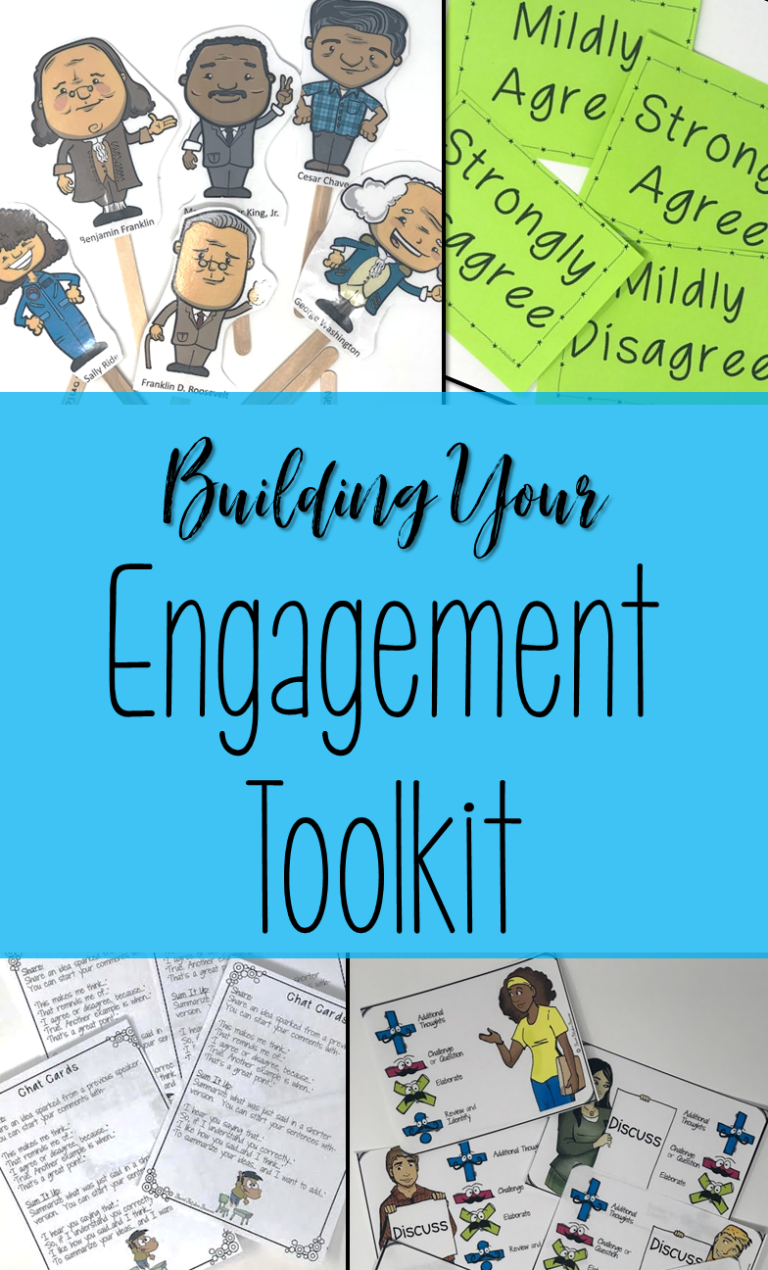
Random response solves the hands problem. Popsicle Stick People are historical figures glued to sticks — students choose one, and you draw a matching stick when you need someone to answer. The same sticks group students, and students will role-play their figure while they read. Grouping Sticks are thirty-six sticks in six colors, numbered one through six, with a shape drawn on the bottom. Group by color for one activity, by shape for the next. Students never catch on that you are controlling every pairing.
Discussion strategies get more than four voices in the room. Add, Subtract, Multiply, Divide gives each student in a group of four a job — add information, challenge an idea, elaborate on a thought, or review everything said and name the most important part. Chat Cards hand students the sentence stems, because “share an idea sparked by a previous speaker” is a skill, not a personality trait. Four Corner Debate puts a provocative statement in the air and makes students physically stand where they land.
Literacy strategies live inside the reading. Question Dice is two dice in an empty crayon box, taped shut — students roll a question word and a helping verb, land on “who” and “could,” and write their own question about the passage. Text Coding gives them a small set of marks and one code to focus on per lesson. Pick a Card hands them a stem when they don’t know how to start.
Review strategies are where the games live. Task Card War runs on plastic soldiers: answer correctly and you take your opponent’s soldier, miss and one of yours goes to the Army Reserve card. Play Dough Processing has students build a three-dimensional model of a vocabulary term, then write a short summary of how the model matches the definition — strict fifteen-minute limit, or you will lose the period. Logic Boxes are terms and connecting phrases written on Jenga blocks, and students build sentences out of them.
Primary source work gets Crop-It, where students slide paper frames across an image to answer a set of questions about it, one crop at a time.
The Pages Nobody Else Writes
Here’s the part I care most about, and the reason the manual is as long as it is.
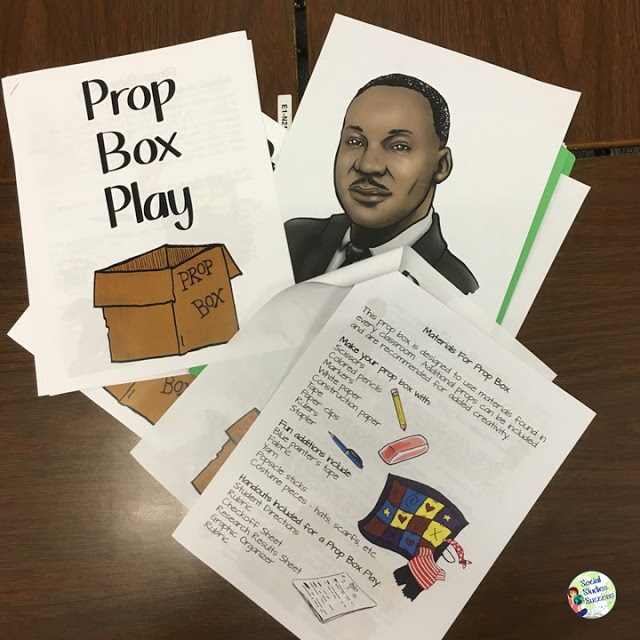
Every strategy gets a second page. Not more theory — a materials list and prep directions. What to buy. How many. What to laminate, what to cut, which bag it goes in when you’re done.
Thirty-six sticks. Ten soldiers per bag. A pair of dice per crayon box. Eight binder clips for the connection card sets.
There is also a shopping list at the front and every printable at the back, because a strategy you have to build from scratch on a Tuesday is a strategy you will not use. That is the entire argument of this resource. The strategies are not new. Prepped and sitting in a bin, ready before you need them — that part is new, and it’s the part that determines whether any of this reaches your students.
One Saturday Afternoon
Set aside one Saturday afternoon before school starts. Print, laminate, cut, bag. Label everything.
Then spend the rest of the year reaching into the bin instead of planning around it.
If you want the whole thing already assembled — all eighteen strategies, the materials lists, and every printable — Building Your Engagement Toolkit is in the shop – or – buy it on TPT.