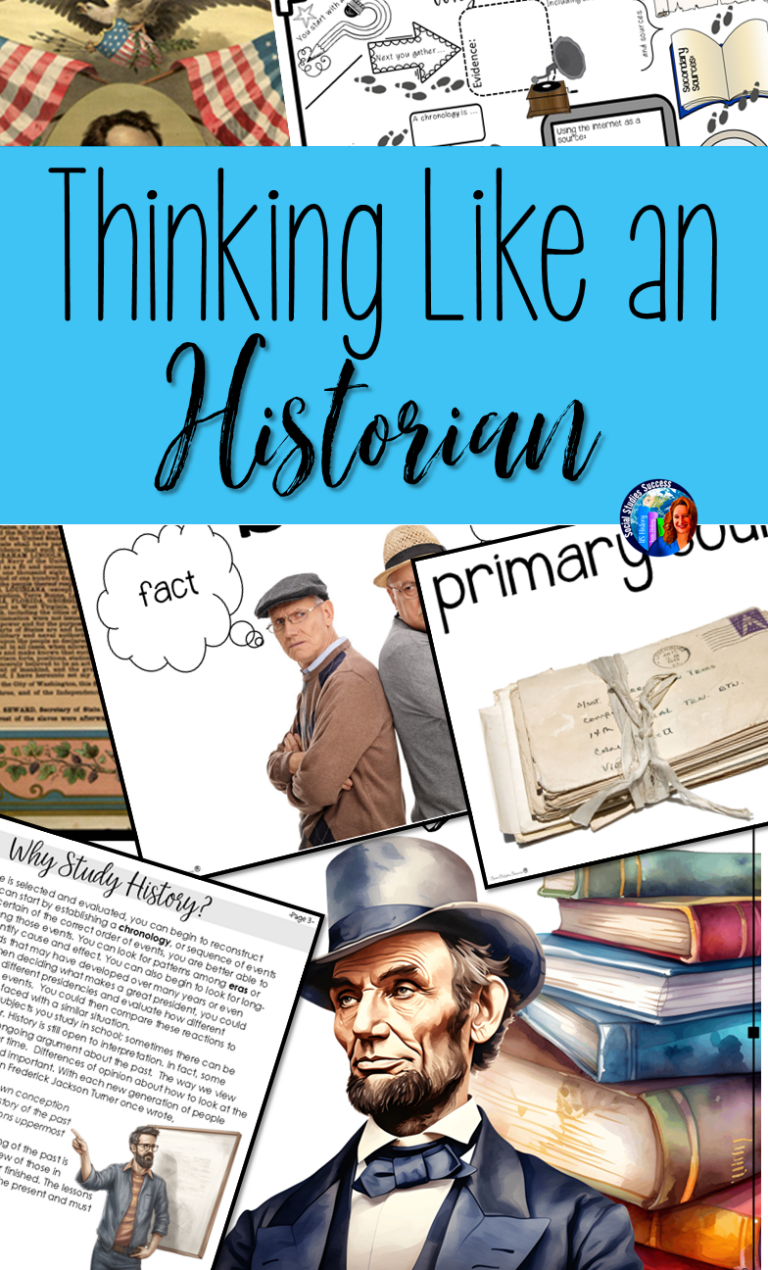
A First-Week Lesson That Sets Up Your Whole Year
Somewhere in the first week of school, a student is going to ask you why they have to take this class. They may say it out loud or they may just say it with their face, but the question is coming.
Most of us spend that first week on syllabus, seating charts, and getting-to-know-you activities — all necessary, none of it history. Then Monday of week two arrives and we launch straight into content, and the kids still don’t know what this subject actually is or why anyone would bother studying it.
I’d rather answer that question head-on while I still have their attention. That’s what my Why Study History? lesson is for. It runs one to two class periods, it answers the essential question Why do we study history?, and along the way it quietly installs almost every routine you’re going to rely on for the next nine months.
Start with the words they’ll use all year
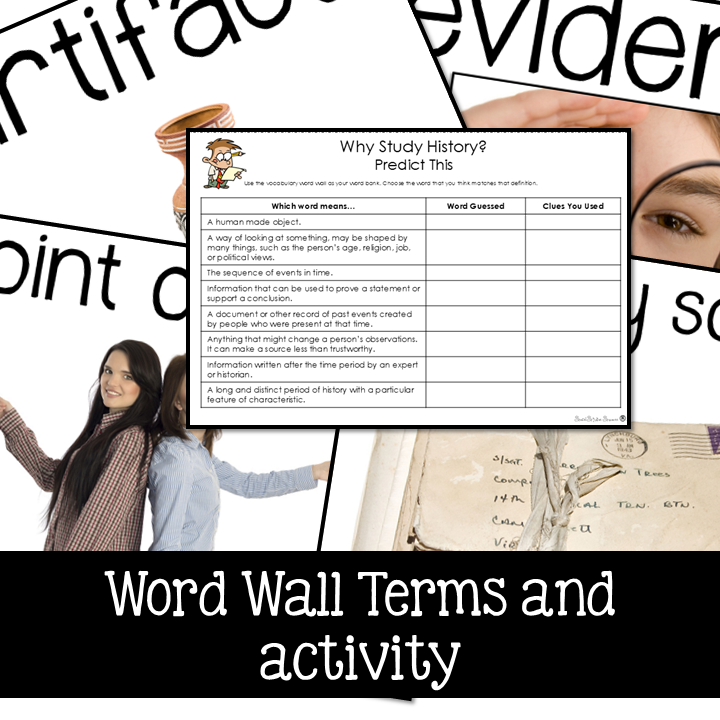 Post the eight vocabulary terms — evidence, artifact, point of view, primary source, secondary source, chronology, bias, and era — on your Word Wall at the focal point of the room before students walk in. These aren’t first-unit words. They’re the words your students will meet on every reading, every document, and every test question from now until May.
Introduce them the way you’ll introduce vocabulary all year: point to each term, pronounce it, and have students repeat it back to you. Then pass out the Predict This activity and let students use the Word Wall as a word bank to match each definition to a term. They won’t get them all right, and that’s fine — the activity asks them to record the clues they used, which is the actual thinking work. Debrief and clear up misconceptions before you move on.
You have also just taught your students, on day two, that the wall is a tool and not decoration. That lesson sticks.
Get them out of their seats
Open the lesson itself with the preview questions and give students four or five minutes to write a response in their notebooks. Then print the numbers 1 through 5, post them around the room, and have students stand in front of the number that matches their answer.
Now you have a human bar graph. Students explain their thinking to the others standing at their number, then share out to the class. In the first week of school, this does double duty: it’s a preview of the content, and it’s the first time many of your students will have talked to each other. Everyone can see who agrees with them. Nobody has to speak alone.
Use the artifact study to build relationships
Put students in groups of four and hand each group a large brown envelope of artifacts to examine. The lesson comes with a set of Abraham Lincoln artifacts — a Wide-Awake Republican Club membership certificate, an 1861 inauguration image, a printed invitation, a photograph of Lincoln with McClellan at Antietam, a family portrait, a postcard, a newspaper article. Students sort through them, examine them, and answer the debrief questions before they know a single thing about how historians work.
Here’s my favorite part, and it’s the reason this lesson belongs in the first week specifically: you can swap in your own artifacts instead. Fill the envelope with objects from your own life — ticket stubs, photos, a program from something you did, a letter someone wrote you. Let your students reconstruct you from evidence. They’ll be dying to know if they got it right, and you will have modeled exactly what historians do while your students learn who their teacher is. I have never seen this fall flat.
Then read, and set the standard for reading
 Give students the Why Study History? reading and the Doodle Notes™. Depending on your grade level, have partners read and take notes together, or guide the whole class through it. Either way, students annotate the text as they go and fill in the matching sections of their notes.
Two things in this reading are worth slowing down for.
The first is the Lincoln quote. The reading includes a line attributed to Abraham Lincoln — “Everything you read on the internet isn’t true!” — and then tells students, a paragraph later, that it isn’t real. Let them fall for it. The list of critical questions that follows (Who is the author? Is it free from bias? Is the information found in several sources? Are the sources cited and verifiable?) lands about a hundred times harder when students have just been fooled by a fake quote in an official-looking school handout.
The second is the section on AI. It makes a point I want my students to hear in the first week rather than in April, when I’m annoyed about an assignment: AI answers sound confident and correct, but sounding right and being right are not the same thing. AI predicts words based on patterns. It can invent facts, dates, and quotations. It usually won’t show you the primary sources behind its answer. That makes it closer to an unverified secondary source than to evidence — and a historian traces every claim back to real evidence. Setting that expectation now, as a matter of historical thinking rather than classroom discipline, changes how the whole conversation goes later. I’ve written more about the dangers of AI in a history classroom if you want to think through where you stand before students ask.
Let them argue about it
Finish with the Why Study History? Spectrum. Students read fourteen statements about why history matters — history helps us understand change, history provides identity to a group of people, history is entertaining and fun, studying history is essential for good citizenship — then choose their top five and rank them from most to least important. They rank independently first, then discuss with their group.
If a ranking activity isn’t the right fit for your classes, use the Dialogue instead. Students write a conversation between two students about why history matters, using at least three of the vocabulary terms. It’s the same thinking with a writing requirement attached, and it’s a nice early sample of what your students can actually do on paper.
End with something that stays on the wall
Have groups share out from the Spectrum, then use the most common responses to build a class anchor chart answering your essential question.
Leave it up. When a student groans about a dense primary source in November, you can point at the chart and ask which of their own reasons this reading is serving. They wrote it. That’s a much better argument than anything I could give them.
If you’re short on time, the lesson shortens easily — skip the human bar graph, the artifact study, or the Spectrum and it still works in a single period. But if you have the two days, spend them. The point of the first week isn’t to get a head start on content. It’s to teach students what this class is going to ask of them, and then show them they can do it.
You can find Why Study History? in my shop. If you have a membership to Social Studies Success®, you will find this lesson in the “Beginning of the Year” tab. Let me know how it goes in your first week!